
Indoor vs Outdoor Cat Lifespan: Why the Gap Is So Big
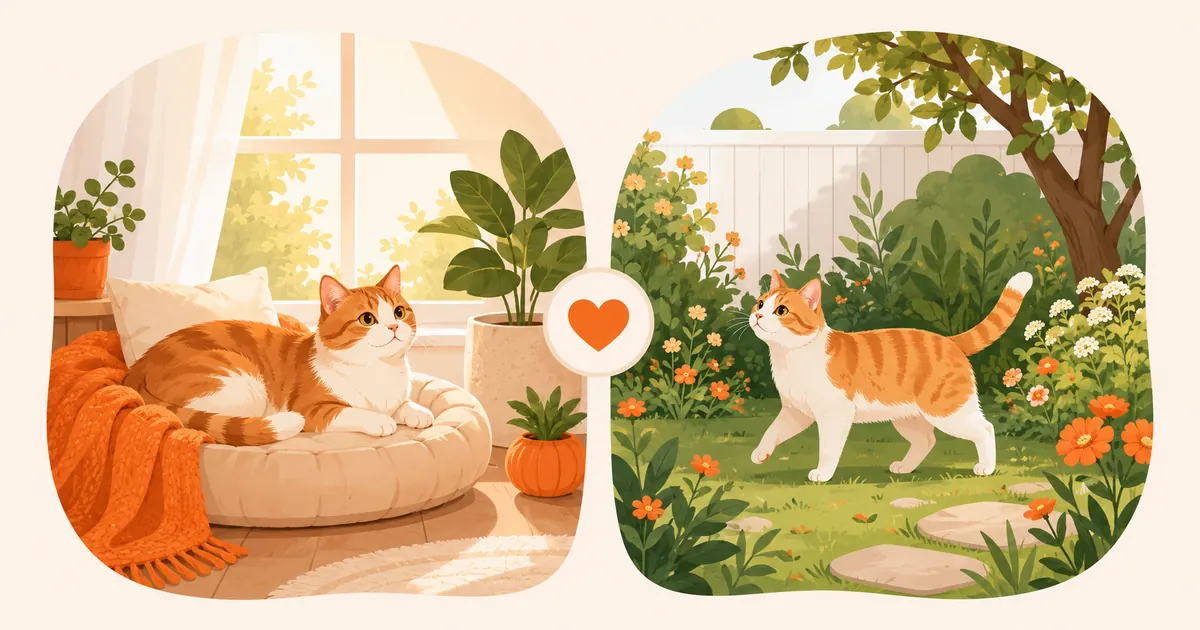
The lifespan difference between indoor and outdoor cats isn’t small. Studies consistently land in the same range: indoor cats live 12–18 years on average, while outdoor-only cats average 2–5 years. Many outdoor cats don’t survive their first year. The gap isn’t about luck. It’s a combination of mortality risks that the outdoor world quietly applies every day.
The four big killers of outdoor cats
1. Vehicles
Cars are the most common cause of trauma death in outdoor cats. Vets in suburban and urban practices see cat road trauma constantly. Many cases involve cats hit at night, on roads they cross every day without incident, until they don’t. Even quiet streets accumulate fatal events over time. A cat that crosses a road twice a day for a year takes more than 700 crossings; the failure rate doesn’t need to be high to be eventually lethal.
2. Predators
Depending on where you live, outdoor cats face coyotes (now in every US state including dense suburbs), free-roaming dogs, raptors (great-horned owls in particular take small cats), foxes, and in some regions bobcats and mountain lions. Coyotes have expanded dramatically into suburbs over the past two decades and routinely take cats from yards. A cat doesn’t need to live near “wilderness” to be at risk.
3. Infectious disease
The major outdoor-cat infections are feline leukemia virus (FeLV), feline immunodeficiency virus (FIV), and panleukopenia (feline distemper). FeLV and FIV are transmitted through fighting and grooming; both shorten lifespan and aren’t curable. Outdoor cats also face higher rates of upper respiratory infections, parasitic infections (fleas, ticks, mites, ear mites, intestinal worms, lungworms), and toxoplasmosis. Indoor cats encounter almost none of these.
4. Toxins and poisoning
Antifreeze (sweet-tasting, lethal in small amounts), rodenticide (cats eat poisoned rodents), garden chemicals, slug pellets, and intentional poisoning all happen outdoors. Antifreeze in particular kills cats every winter; the dose required is minuscule and the symptoms appear too late to easily reverse.
Why outdoor cats die younger on average even when they look fine
Most outdoor cats don’t die from one event. They accumulate. A cat with chronic FIV is more vulnerable to abscesses from fights. A cat with parasites carries a long-term inflammatory load. A cat dehydrated from heat or hiding from predators eats and drinks less. Each insult is survivable; the set of them subtracts years.
The other quiet factor is that outdoor cats often go undiagnosed. A cat with early kidney disease who sleeps in a barn isn’t getting bloodwork. A limping cat hiding for a day after a coyote chase isn’t getting examined. Outdoor cats receive less veterinary care simply because problems are less visible to their owners.
From the research
Veterinary consensus, including guidance from UC Davis, puts indoor cats at roughly 15 to 17 years against just 2 to 5 years for cats that live mostly outdoors. UK insurance and primary-care datasets point the same way: median lifespans for indoor-only cats run well into the teens, while outdoor cohorts often sit at 3 to 5.
“But indoor cats are unhappy and bored.”
This concern is real and worth addressing; just not by sending cats outside unsupervised. Bored indoor cats are unhappy. Indoor cats with enriched environments are not.
What enrichment looks like in practice:
- Vertical space. Cat trees, shelves, window perches. Cats use the third dimension constantly; flat homes feel small.
- Daily play. Two short sessions (10–15 minutes each) with a wand toy mimicking prey simulates the hunt-catch-kill-eat cycle that drives so much cat behavior.
- Puzzle feeders. Cats are foragers; bowls are boring. A puzzle feeder converts mealtime into 20 minutes of low-grade hunting.
- Window views with bird traffic. “Cat TV” is real. A bird feeder placed outside a window gives indoor cats hours of focused engagement.
- Scratching surfaces in multiple textures. Sisal, cardboard, carpet. Both vertical and horizontal.
- Other cats, if the personality fits. A bonded pair or trio of compatible cats is enrichment for each other.
Middle-ground options if you want your cat to experience the outdoors
Catios
A “catio” is a screened or wire-mesh enclosure attached to a window, door, or yard that lets a cat be outdoors without contact with predators, vehicles, or wandering cats. They range from a window-mounted box (a few hundred dollars) to a full screened porch. Catios remove almost all of the outdoor mortality risk while preserving the sights and smells of being outside.
Leash walking
Many cats, particularly those introduced to a harness in kittenhood, take to leash walks well. A well-fitted H-style or vest harness is essential; collar leashes are dangerous for cats. Outdoor leash walks should still avoid contact with stray cats, dogs, and high-traffic areas.
Supervised yard time
A fully fenced yard with the right add-ons (Oscillot rollers on the fence top, or a complete coyote-roller system) plus your supervision can allow free roaming with much lower risk than full outdoor access. Unfenced supervised yard time is much riskier than it looks. Cats can clear most fences quickly when motivated.
If your cat already goes outside
If you’ve had an indoor/outdoor cat for years and they’re visibly happy with that arrangement, you don’t need to feel guilty. But there are still things that meaningfully reduce risk:
- Keep them in at dusk and overnight. Most predator activity and most car strikes happen at low-light times.
- Spay or neuter. Reduces roaming, fights, and disease transmission dramatically.
- Keep all vaccines current including FeLV.
- Use a breakaway collar with ID. Microchip too.
- Regular parasite prevention. Year-round.
- Annual bloodwork from age 5 on, twice yearly from age 7. Outdoor cats hide illness more, so screening catches more.
Want to see how those extra years of lifespan map to human-year equivalents? Try our cat age calculator to see what 12 vs 17 years of cat life actually looks like translated to a human scale.
What this comes down to
The indoor-vs-outdoor decision has the largest effect on cat lifespan of anything an owner controls. Indoors with enrichment beats outdoors-with-risks on essentially every quality-of-life measure that’s been studied. If your cat is currently indoor-only and you’ve been wondering whether to let them out, the straight answer is: don’t. Build a better indoor world for them instead.
Calculate Your Cat’s Age in Human Years →Sources
- UC Davis Veterinary Medicine. Guidance on indoor vs outdoor cat lifespan and safety.
- O’Neill DG, Church DB, McGreevy PD, et al. “Longevity and mortality of cats attending primary care veterinary practices in England.” Journal of Feline Medicine and Surgery, 2015.
- American Veterinary Medical Association. Free-Roaming Abandoned and Feral Cats Policy.
Written by the Cats Age Calculator editorial team · How we research & fact-check