
Understanding Cat Life Stages: Kitten to Geriatric
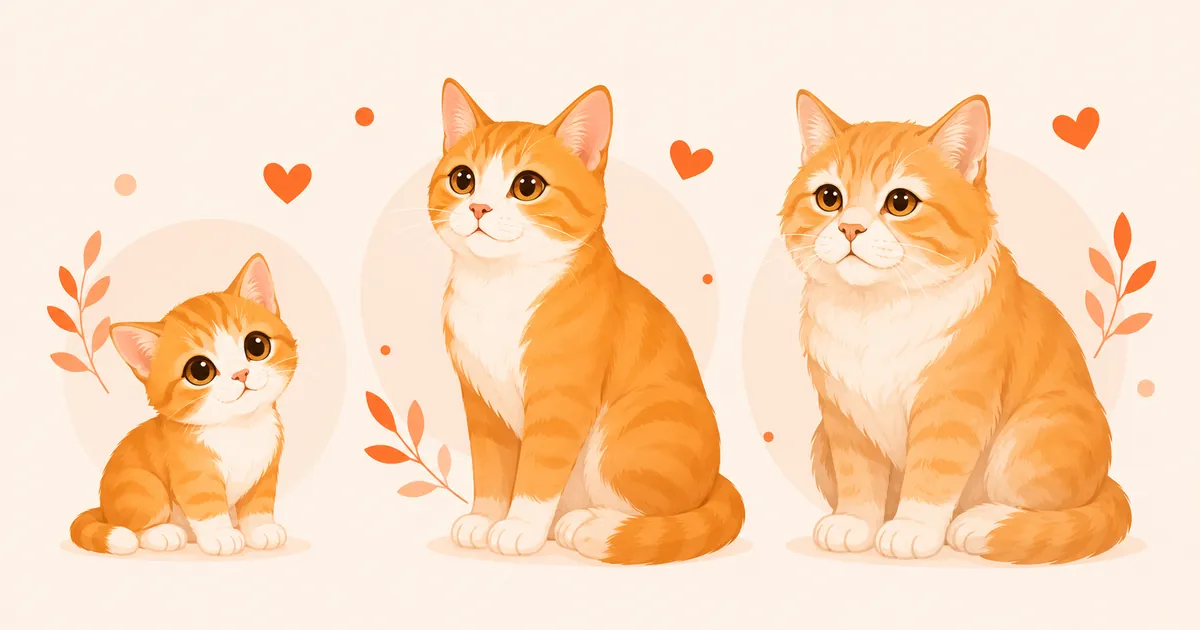
Most cat owners think in two stages: kitten and adult. Veterinarians think in six. The difference matters, because the food, vet visits, and home setup that work for a one-year-old don’t work for a fifteen-year-old. And the line between “adult” and “senior” crosses earlier than most people realize.
The American Animal Hospital Association (AAHA) and the American Association of Feline Practitioners (AAFP) jointly publish feline life stage guidelines that group cats into six stages: Kitten, Junior, Adult, Mature, Senior, and Geriatric. The categories are based on physical development, behavior, and the medical issues most likely to appear, not on arbitrary birthdays. Knowing which stage your cat is in is the most useful framework for understanding what they need next.
Stage 1: Kitten (Birth to 6 months)
The kitten stage is where the most change happens in the shortest time. A newborn kitten weighs about 100 grams (less than a stick of butter), and roughly doubles its weight in the first week. Eyes open around day 10. Teeth start coming in at three weeks. By eight weeks, kittens are eating solid food, walking confidently, and beginning the developmental window that shapes their adult personality.
Between weeks 2 and 7 is the critical socialization period. Kittens handled gently by humans during this window grow into adult cats who are comfortable being held, brushed, and examined. Kittens isolated during this window often stay shy or fearful for life. This is the most important window in a cat’s social development, and it closes faster than most people expect.
Kittens at this stage need:
- Kitten-formula food: higher calorie, higher protein, with the right calcium-to-phosphorus ratio for growing bones. Adult food does not contain enough.
- A first vet visit at 6–8 weeks, then a vaccine series every 3–4 weeks until about 16 weeks.
- Spay or neuter typically scheduled around 5–6 months, before sexual maturity.
- Gentle exposure to humans, sounds, carriers, and other animals so they grow up confident.
Stage 2: Junior (6 months to 3 years)
By six months, kittens look almost full-sized but they are still teenagers. The Junior stage is where the body finishes assembling itself: skeletal growth continues until about 12 months, hormonal maturity kicks in around 6–9 months (if not neutered), and most cats reach their adult weight somewhere between 10 and 18 months. Large breeds like the Maine Coon are still growing at three years old.
Behaviorally, Junior cats are at peak chaos. The wall-climbing, 3 a.m. zoomies, curtain-shredding phase usually lands here. Personality solidifies during this stage too. Cats who were socialized well as kittens become friendly adults, and those who weren’t often stay wary.
Transition from kitten food to adult food between 10 and 12 months, depending on breed. Annual vet visits become the default. This is also the right age to establish routines that will carry into adulthood: scheduled feeding, regular nail trims, comfort with carriers and car rides.
Stage 3: Adult (3 to 6 years)
The Adult stage is where a cat is at full physical capacity and the body is generally low-maintenance. Most adult cats hold their weight steady, sleep 14–16 hours a day, and need only minor health management.
This is also the stage where small problems can quietly become big ones. Cats are champion hiders of illness, an instinct from their wild ancestors where visible weakness drew predators. A prime-age cat with early kidney disease, mild hyperthyroidism, or developing dental issues may show no obvious symptoms for months or years. Annual wellness bloodwork starting at age 3 or 4 is the cheapest catch-it-early move you can make.
Why it matters
Cats hide pain. By the time most owners notice symptoms, a chronic disease has often been progressing for months. Bloodwork once a year, even on a healthy-looking cat, catches kidney and thyroid issues years earlier than waiting for symptoms ever will.
Watch for: weight changes (gain or loss), dental tartar, subtle changes in jumping ability, and any shift in litter box habits. These are the four earliest cat-illness signals.
Stage 4: Mature (7 to 10 years)
Mature cats often look identical to prime-age cats but are biologically aging. Around age 7, many vets recommend shifting from annual to twice-yearly vet visits (they become the standard recommendation by age 10, the point at which AAHA/AAFP guidelines already class a cat as senior), because diseases that progress slowly (chronic kidney disease, hyperthyroidism, diabetes, dental disease, arthritis) become much more common in this stage and benefit hugely from early detection.
Weight management becomes the central issue. Indoor cats slow down naturally, but most owners don’t reduce food. The result is the most common preventable cat health problem in the developed world: feline obesity. An overweight 9-year-old cat is at significantly higher risk for diabetes, joint disease, and skin infections than a lean one. If your cat’s waistline has disappeared from above, talk to your vet about gradual weight reduction.
This is also when you should start watching for arthritis. Studies estimate that more than 60% of cats over age 6 have some degree of degenerative joint disease, but vets diagnose it in only a tiny fraction. The reason: cats with arthritis don’t limp the way dogs do. They jump less, sleep more, miss a litter box edge, or stop grooming their lower back. None of those look like “pain” to an owner. They are.
Stage 5: Senior (11 to 14 years)
By eleven, your cat is the rough equivalent of a 60-year-old human and is now officially senior. Most cats at this stage have at least one chronic condition that needs ongoing management: kidney disease, hyperthyroidism, dental disease, arthritis, or some combination. The goal of senior care shifts from prevention to management: keep conditions stable, maintain weight and muscle, and adapt the environment to fit a less agile body.
Practical changes that help:
- Lower-sided litter boxes so stiff hips don’t make the box a chore.
- Steps or ramps to favorite resting spots, especially beds and windowsills.
- Multiple water sources, including a fountain (senior cats are prone to dehydration).
- Senior-formula food with controlled phosphorus and easily digestible protein.
- Twice-yearly bloodwork, including a urinalysis. Kidney values move quickly at this stage and warrant tracking.
Don’t take a quiet, sleepy senior cat as a sign that “they’re just old.” New lethargy, new hiding, new loss of appetite, or new vocalizing at night are nearly always a medical issue, not a personality shift.
Stage 6: Geriatric (15+ years)
Geriatric cats are the medical equivalent of humans in their late 70s and 80s. Many cats live well into this stage. It’s no longer rare for indoor cats to reach 18 or 20. The focus is comfort, hydration, and stability. Most geriatric cats are managing two or three chronic conditions, and small changes in routine can have outsized effects on quality of life.
Cognitive changes appear in this stage too. Cat dementia (clinically called feline cognitive dysfunction) affects an estimated 28% of cats aged 11–14 and over 50% of cats aged 15+. Signs include nighttime yowling, disorientation, changes in social interaction, and loss of established habits like reliable litter box use. It’s a real medical condition and there are management options, so it’s worth raising with your vet rather than dismissing as “old age.”
What still works at this stage: gentle interaction, predictability, easy access to food and water and litter, soft warm sleeping spots, and patience. Geriatric cats are often deeply affectionate companions; they’ve simply downshifted their pace.
Putting it all together
The reason vets break cat life into six stages and not two is that the right care for a 1-year-old, a 5-year-old, and a 15-year-old are genuinely different. The most common avoidable cat health problems (obesity in mature cats, late-caught kidney disease in seniors, undiagnosed arthritis in older adults) all come from treating cats as if they’re still in their Adult stage long after they’ve moved past it.
If you’re unsure where your cat falls, our cat age calculator uses the AAHA-aligned formula to convert your cat’s chronological age into a life stage and its human equivalent. From there, the right care decisions follow naturally.
Calculate Your Cat’s Age & Life Stage →Sources
- American Animal Hospital Association & American Association of Feline Practitioners. Feline Life Stage Guidelines. aaha.org
- Slingerland LI, Hazewinkel HA, Meij BP, et al. “Cross-sectional study of the prevalence and clinical features of osteoarthritis in 100 cats.” The Veterinary Journal, 2011.
- Gunn-Moore DA, Moffat K, Christie LA, Head E. “Cognitive dysfunction and the neurobiology of ageing in cats.” Journal of Small Animal Practice, 2007.
Written by the Cats Age Calculator editorial team · How we research & fact-check