
Cat Breed Lifespan Chart: How Long Do Cat Breeds Live?
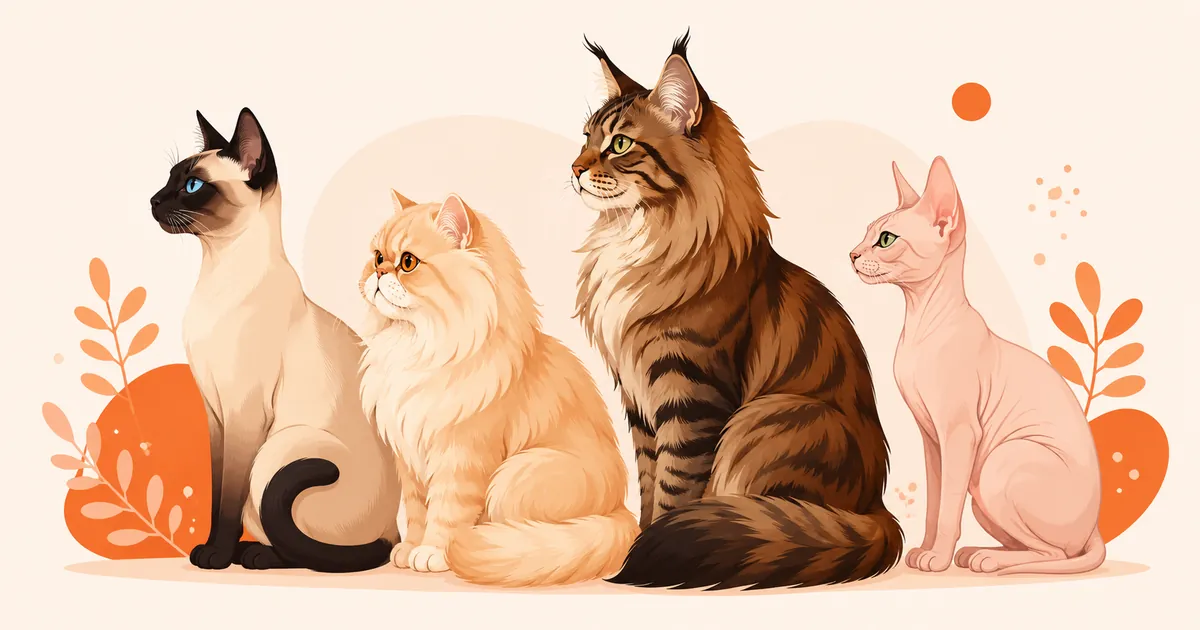
Breed shapes how long a cat lives, mostly through inherited health risks, though lifestyle (indoor versus outdoor above all) matters even more. This sortable chart lists the average lifespan of 40+ popular cat breeds, along with each breed’s size and the health issues most likely to affect how long it lives. Click any column heading to sort, or search for a specific breed.
How to use this chart
Lifespans are typical ranges for cats kept indoors with good veterinary care. Individual cats vary. Want your own cat’s age in human years? Use the cat age calculator.
| Key health & longevity notes | |||
|---|---|---|---|
| Domestic Shorthair | 12–18 | Medium | Mixed ancestry gives hybrid vigor and typically long, healthy lives. Full lifespan guide. |
| Domestic Longhair | 12–18 | Medium | Like the shorthair, broad genetic diversity supports a long lifespan. |
| Maine Coon | 10–15 | Large | Watch for hypertrophic cardiomyopathy (HCM) and hip dysplasia. Full lifespan guide. |
| Persian | 12–17 | Medium | Flat-faced breathing issues and polycystic kidney disease (PKD) are common. Full lifespan guide. |
| Siamese | 12–20 | Small–Medium | Generally long-lived; some reach their early 20s. Full lifespan guide. |
| Ragdoll | 12–17 | Large | HCM is the main breed-specific longevity risk. Full lifespan guide. |
| Bengal | 12–16 | Medium–Large | Active and generally healthy; HCM is the main watch item. Full lifespan guide. |
| British Shorthair | 12–17 | Large | Robust breed; HCM screening is recommended. |
| Sphynx | 8–14 | Medium | Hairless skin needs sun and cold protection; elevated heart-disease rate. Full lifespan guide. |
| Abyssinian | 9–15 | Medium | Watch for pyruvate kinase deficiency and progressive retinal atrophy. |
| Scottish Fold | 9–13 | Medium | The fold gene also causes painful degenerative joint disease. |
| Russian Blue | 15–20 | Medium | One of the most consistently long-lived and healthy breeds. |
| Norwegian Forest Cat | 12–16 | Large | Hardy natural breed; HCM and glycogen storage disease are risks. |
| Burmese | 15–18 | Medium | Long-lived; prone to diabetes and, in some lines, a cranial defect. |
| Birman | 12–16 | Medium–Large | Considered a healthy breed with few hereditary problems. |
| Oriental Shorthair | 12–15 | Small–Medium | Shares the Siamese line's general health profile. |
| Devon Rex | 9–15 | Small | Prone to a hereditary muscle condition and patellar luxation. |
| Cornish Rex | 11–15 | Small | Sparse curly coat; generally a healthy breed. |
| American Shorthair | 15–20 | Medium | Famously durable, long-lived working-cat stock. |
| Exotic Shorthair | 8–15 | Medium | Same flat-faced and PKD concerns as its Persian ancestor. |
| Siberian | 10–18 | Large | Hardy natural breed; HCM is the main concern. |
| Himalayan | 9–15 | Medium | Persian-derived: flat-face breathing issues and PKD. |
| Tonkinese | 15–20 | Medium | Generally healthy and notably long-lived. |
| Savannah | 12–20 | Large | Tall, athletic hybrid; generally robust, with HCM watched. |
| Manx | 10–14 | Medium | The tailless gene can cause spinal defects (Manx syndrome). |
| Turkish Angora | 9–14 | Medium | Some white, blue-eyed lines carry congenital deafness. |
| Egyptian Mau | 9–20 | Medium | Athletic and generally healthy (published lifespan data is limited). |
| Ragamuffin | 12–17 | Large | Related to the Ragdoll; HCM and PKD are the main concerns. |
| Selkirk Rex | 14–20 | Medium–Large | Curly-coated; can inherit Persian and British HCM and PKD risk. |
| Singapura | 11–15 | Small | Among the smallest breeds; PK deficiency occurs in some lines. |
| Balinese | 12–16 | Small–Medium | Long-haired Siamese; lifespan figures vary widely by source. |
| Bombay | 9–15 | Medium | Generally healthy; may share some Burmese respiratory traits. |
| Chartreux | 12–15 | Medium | Sturdy breed; patellar luxation and hip dysplasia are noted. |
| Somali | 11–16 | Medium | Long-haired Abyssinian; same PK deficiency and retinal risks. |
| Turkish Van | 13–17 | Medium | Hardy swimming cat; generally healthy. |
| Ocicat | 12–18 | Medium–Large | Spotted but fully domestic; generally a healthy breed. |
| American Curl | 12–16 | Small–Medium | The curled-ear mutation is not tied to health problems. |
| Japanese Bobtail | 9–15 | Medium | Bobbed tail without the Manx spinal defects; a healthy breed. |
| Korat | 10–15 | Small–Medium | Carries gangliosidosis; responsible breeders DNA-test for it. |
| Lykoi | 12–15 | Small–Medium | Partly hairless skin needs care; otherwise a healthy breed. |
| Munchkin | 12–15 | Small | Short-legged gene; lordosis and pectus excavatum in some lines. |
| Snowshoe | 14–20 | Medium | Siamese and American Shorthair cross; generally long-lived. |
No breeds match your search.
Can’t find tabby, calico, or tuxedo?
That’s because tabby, calico, tortoiseshell, and tuxedo are coat patterns and colors, not breeds. A tabby cat (the striped or swirled pattern with the tell-tale “M” on the forehead) can show up in dozens of breeds, and most tabbies are mixed-breed cats with no single pedigree. So there’s no separate “tabby lifespan”: it depends on the cat underneath the pattern.
If your cat is a pattern rather than a known breed, look at the Domestic Shorthair or Domestic Longhair rows above (12–18 years). Mixed-breed cats often live as long as or longer than purebreds, thanks to a more diverse gene pool. Purebred tabbies, calicos, and tuxedos follow their breed’s row instead.
Calculate Your Cat’s Age & Life Stage →About this data & sources
Lifespan ranges were compiled and cross-referenced from established veterinary and pet-health references. Where sources differed, we reconciled toward the consensus and leaned on the figures most consistent with each breed’s known health profile. These ranges are guidance for healthy, well-cared-for cats, not guarantees: diet, weight, indoor living, and veterinary care all move the number.
- PetMD: cat breed profiles (petmd.com).
- Hill’s Pet: cat breed guides (hillspet.com).
- ASPCA Pet Health Insurance: cat breed facts (aspcapetinsurance.com).
Written by the Cats Age Calculator editorial team · How we research & fact-check