
When Is a Cat Fully Grown?
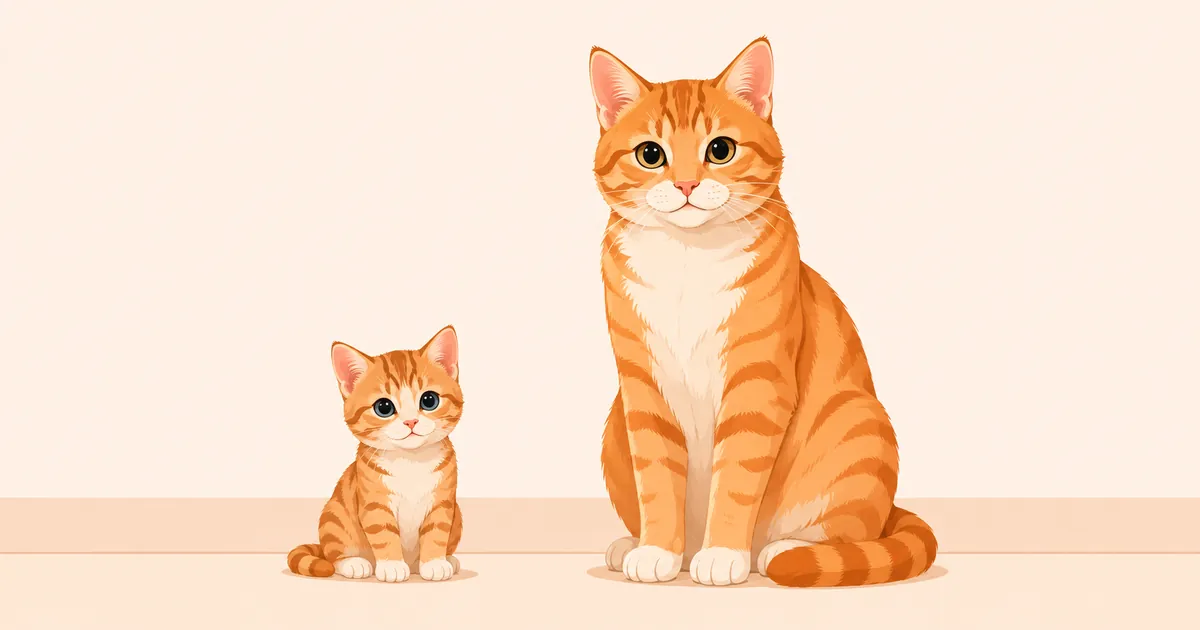
Most domestic cats are physically mature by their first birthday and close to their adult weight by 12–18 months. Some breeds, Maine Coons in particular, keep filling out until they’re three or four years old. “Fully grown” isn’t a single milestone; it’s a set of different developmental endpoints that finish at different times.
What “fully grown” actually means
Three separate milestones get blurred together in everyday conversation:
- Sexual maturity arrives first, typically 6–9 months. A cat that can reproduce isn’t a kitten anymore, but it’s not fully grown.
- Skeletal maturity, when the long-bone growth plates close, happens around 10–14 months in most cats. After this, the cat won’t get noticeably taller or longer.
- Adult weight and muscle filling-out can continue for another 6–24 months past skeletal maturity, depending on breed.
So a 12-month-old cat that’s reached adult height is technically “skeletally mature” but may still gain another pound or two of muscle and weight before reaching true adult body composition.
Average growth timeline by breed type
Small to medium domestic cats (most cats)
Domestic shorthairs, longhairs, Siamese, Burmese, Russian Blue, Abyssinian, and most common breeds finish growth between 10 and 14 months. Adult weight ranges 7–12 pounds depending on individual.
Medium-large breeds
British Shorthair, Persian, Ragamuffin, Birman, and Norwegian Forest Cat continue to fill out for 2–3 years. They’re skeletally mature earlier but their adult muscle and weight take longer to settle.
Maine Coon and Ragdoll
The largest pet breeds. Maine Coons and Ragdolls keep growing until 3–4 years old. A 12-month-old Maine Coon is typically only 60–70% of its adult weight. Don’t evaluate “is my Maine Coon big enough?” before age 3.
Savannah and Bengal
Bengals are usually full size by 18–24 months. Savannah cats, especially early-generation (F1–F3), can continue to grow until age 3.
How to tell if your cat is done growing
Cats don’t hit a single growth-done moment. The reliable signals:
- Weight has been stable for 3–4 months without dietary change.
- Body length and shoulder height haven’t increased noticeably in 6 months.
- Vet visit shows growth plates closed on x-ray (if you happen to take one for another reason).
- Your cat is past the breed’s typical growth-end age (1 year for most cats, 3–4 for Maine Coons).
When to switch from kitten food to adult food
Most small/medium breeds: 10–12 months. Medium-large: 12–15 months. Maine Coons, Ragdolls, and other large-late breeds: 18–24 months. Switching too early leaves a growing cat undernourished; switching too late risks adult obesity. When in doubt, ask your vet at the 1-year appointment.
Body condition score: more useful than weight
Cat body weight varies hugely by breed. A 7-pound Singapura is healthy; a 7-pound Maine Coon is critically thin. The more useful metric is body condition score (BCS), a 1–9 scale your vet uses at every visit. A BCS of 4–5 is ideal: ribs easily felt under a thin fat layer, visible waist when viewed from above, slight tummy tuck from the side. Watching BCS through the growth period and into adulthood tells you more about whether your cat is on track than the scale ever will.
Personality maturity vs physical maturity
Cats often reach their final size before they reach their final personality. Most cats settle into adult behavior patterns (calmer energy, more predictable routines) somewhere between 18 months and 3 years. A 12-month cat that’s physically full-grown but still bouncing off walls isn’t abnormal; they’re just a young adult.
Common misconceptions
- “Neutering stunts growth.” The opposite is closer to true. Neutered cats often grow slightly larger than intact cats because growth plates stay open a few months longer. Health benefits of early neutering vastly outweigh this.
- “Bigger cats live shorter lives.” Unlike dogs, body size within cats is not strongly correlated with lifespan. A healthy Maine Coon at 18 pounds doesn’t have a shorter life expectancy than a 9-pound DSH because of size.
- “My one-year-old looks small. Something’s wrong.” Probably not. Small cats are common and healthy. If body condition score is normal and the vet has cleared bloodwork, your cat is fine.
Want to know exactly where your cat sits in life-stage terms? Our cat age calculator uses the AAHA framework to translate any age into a life stage and human-year equivalent.
What this comes down to
For most cats, “fully grown” lands somewhere between 10 and 14 months. For larger breeds, especially Maine Coons and Ragdolls, growth continues to age 3 or 4. The right time to transition to adult food, evaluate weight as “adult,” and stop expecting noticeable size changes depends on breed, not the calendar alone.
Calculate Your Cat’s Age & Life Stage →Sources
- American Association of Feline Practitioners. Feline Life Stage Guidelines.
- Laflamme DP. “Development and validation of a body condition score system for cats.” Feline Practice, 1997.
- Root MV, Johnston SD, Olson PN. “The effect of prepuberal and postpuberal gonadectomy on radial physeal closure in male and female domestic cats.” Veterinary Radiology & Ultrasound, 1997.
Written by the Cats Age Calculator editorial team · How we research & fact-check